My sessions vary from 90 minutes to multiple hours long, like on weekends where I have very little to do other than crank out entire chapters in a day.
If I’m writing at the bar, I skip the music and art because I write off my iPad and my headphones don’t currently function with my iPad. There, I order a drink and a snack, and skip to number 3. (While writing this, I just realized I could use my phone. Learn from my mistakes.)
- Open up my playlists and play the appropriate playlist. For Like A Flame, I have 4 playlists. One for each of my main three characters and one for the setting at large.
For Like A Flame, I usually start with the “gooey” part of Basil’s playlist and then realize I’m writing a revolutionary scene or vice versa. (There are distinct sections of “revolution,” “please hydrate Tom Waits for the love of god,” versus “gooey” for Basil’s playlist.) - Open up Scrivener, open up art inspiration side by side with the current chapter I’m working on. This is a major reason why I had two monitors initially, so I could both write and look at my playlists or my art inspiration.
I highly recommend getting some art commissioned or looking up celebrities to fan-cast your work in progress! I have both, but I started with art rather than the other way around. You don’t need to have a Pintrest board, but I recommend having something you can use that works for you where you can throw pictures or screenshots of stuff that inspires you! - I have Scrivener set up so each chapter is a file and I have copied the outline for that chapter already, so I don’t need to refer to different files.
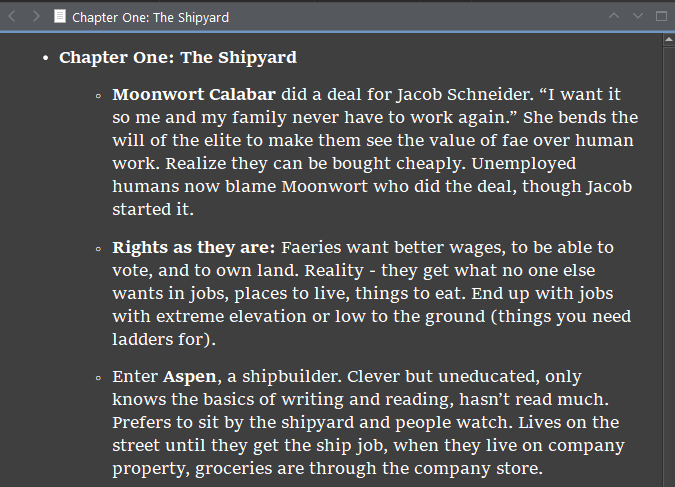
4. Write what’s in the outline first. This is my version of “eat your veggies first.” For chapter one, this meant a flashback to Moonwort Calabar’s dingy Faerie Deals office, setting up how deals worked, and then flashing to meeting Aspen and building the world up from there. I had a very vivid scene in my head of Aspen sleeping on the street and then heading to work, so I started there.
5. From there, make dynamic and interesting characters for your lead to interact with to build the in-between the outline and what needs to go on the page. In chapter one, I realized I only had the foreman for Aspen to talk to and needed someone to move the plot along, so I made up Oskar Moshe, his Jewish mentor at the shipyard. Fast forward to now where I have an appendix of character names.
6. A lot of my sessions are writing stream of consciousness until I realize I’m 2.5k words deep because dialogue writes easily for me. I try not to edit as I go, but sometimes it gets the better of me. Like A Flame has very distinctive scenes in my head, but that’s because I did the outlining ahead of time. If pants-ing is more your speed, try writing the scenes that you have the most imagery first and then glue your pieces together. That’s what I used to do and it worked very well!
Now, however, I’m such an organizer and planner that it doesn’t work for me anymore – in a former life I was a librarian.
 Forest Hackley
Leave a comment